- Underwrite.In
- Posts
- Quick secrets on how to benchmark AI performance
Quick secrets on how to benchmark AI performance
Things that you really need for a transformation.

Shen Pandi
December 12, 2025
Allianz spent millions deploying AI for travel underwriting.

They saw a 15% revenue growth and 30-50% reduction in cost.
Meanwhile, most other insurers watched their AI projects die in pilot purgatory.
According to McKinsey's 2024 GenAI report, only 22% of corporate functions rolled out AI for even one use case.
The rest are still experimenting, still testing, and still measuring nothing.
The AI in insurance market hit USD 3.9 billion in 2025, racing towards USD 45.74 billion by 2031.
But here's the catch. 42% of companies abandon most AI initiatives before production. That's up from 17% just one year ago.
The problem isn't AI. It's measurement itself. You can't improve what you don't track. And most underwriting teams track nothing beyond ‘did it deploy?’
That’s why, we at Underwrite.In, have built an AI-powered underwriting assistant, that provides you with the necessary data and context to measure progress and identify areas for improvement.
No more guessing. No more abandoned pilots. Let me show you how to make AI actually work for underwriting!

A quick snapshot of how Underwrite.In helps you see tangible value through data.
Why does benchmarking with AI separate you from the rest?
You will agree that traditional underwriting tracked three things - cycle time, bind rate, and loss ratio.
Underwriting using AI-powered tools or platforms demand accuracy and improvement in every aspect of underwriting. Miss even one, your transformation fails.
Here are three key reasons why benchmarking with AI should be your new normal.
To validate AI model performance and accuracy
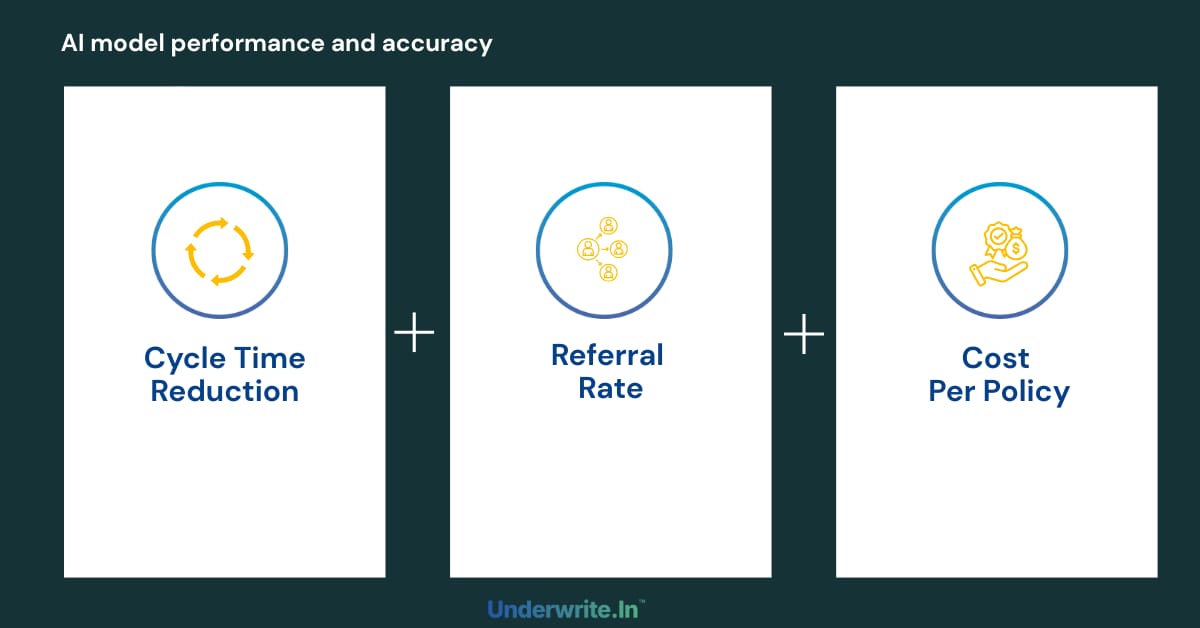
Metrics are essential to determine if the AI models are making better, more accurate, and more consistent decisions than your human underwriters or previous models.
Benchmarking ensures the models meet acceptable risk and performance thresholds before deployment.
Key metrics here are:
Cycle Time Reduction - Measuring the time it takes to issue a policy before and after the transformation. A successful change should significantly decrease this time.
Referral Rate - Tracking how often an application needs a manual underwriter review versus being automated. A transformation often aims to lower the referral rate for straight-through processing.
Cost Per Policy - Calculating the expense incurred in underwriting a single policy. Transformation should generally lower this cost.
To identify and mitigate algorithmic bias
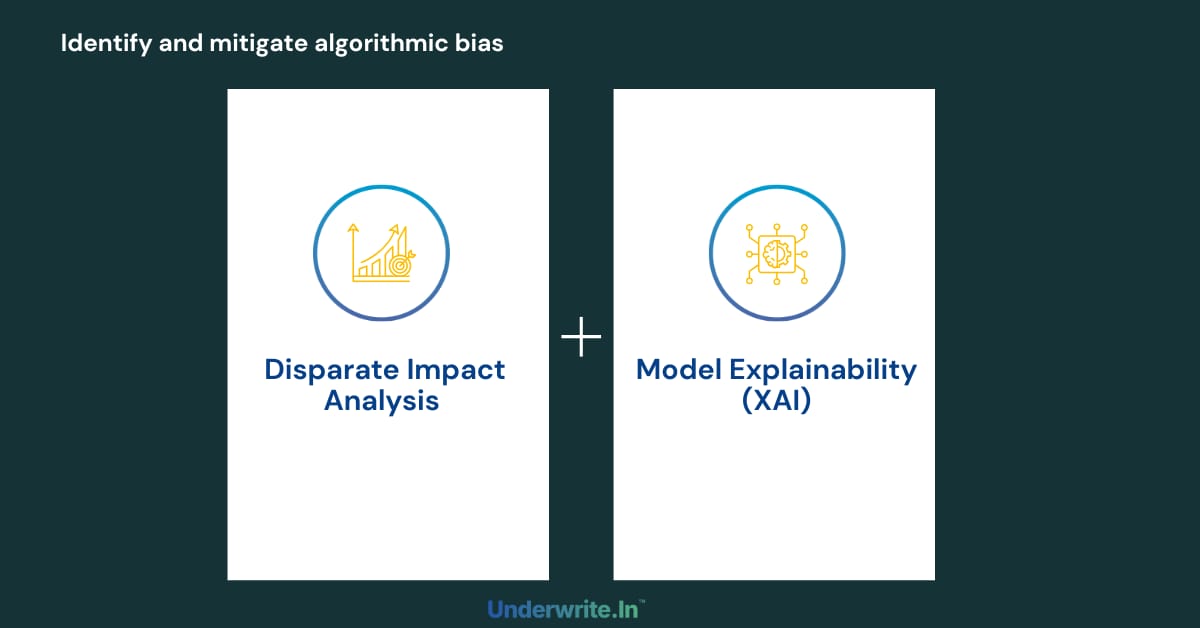
AI models can inadvertently learn and amplify biases present in historical data, leading to unfair or discriminatory underwriting decisions.
Benchmarking across different demographic segments is the only way to proactively find and fix this bias.
Key metrics here are:
Disparate Impact Analysis - Comparing acceptance rates, pricing, and decision outcomes across different customer segments. This benchmark is often an equitable or statistically insignificant difference between groups.
Model Explainability (XAI) - These metrics focus on which data features the AI prioritized for a decision. This allows your team of underwriters to challenge the model's logic if it relies on questionable or biased inputs.
To quantify productivity gains and scalability
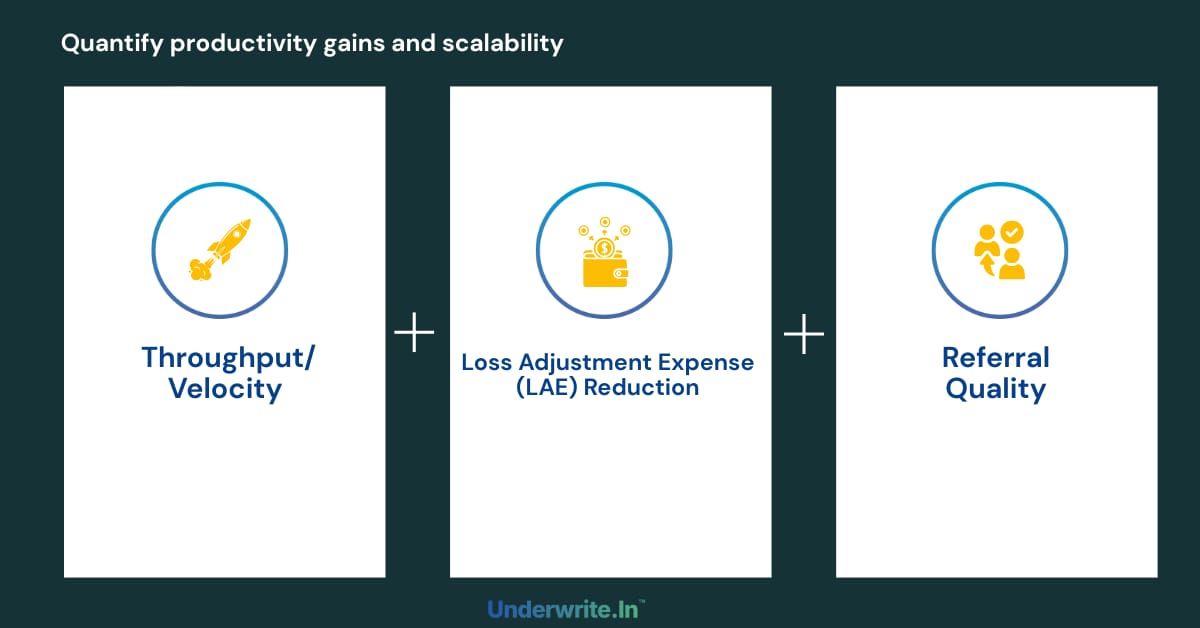
A major goal of using AI is to allow human underwriters to handle more complex cases faster.
Metrics quantify these gains, while benchmarking helps compare the efficiency of AI-assisted underwriting versus the purely manual process, justifying your significant technology investment.
Key metrics here are:
Throughput - Measuring the increase in the number of applications processed per hour, especially during peak volume.
Loss Adjustment Expense (LAE) Reduction - Tracking the total cost savings realized from automating tasks like data intake and initial risk scoring, freeing up underwriter time.
Referral Quality - Benchmarking the quality of cases the AI refers to a human. A successful AI transformation ensures human underwriters only handle the most complex and ambiguous applications, not simply routine ones.
In an unrelated topic, are you team members lacking the right AI skills to adopt to the latest tools and softwares?
We have an insightful session by two modern-day AI leaders that teach professionals how to build trust artefacts and how to pivot into AI-trust work.

What about the gaps when setting up AI-based benchmarking?
You're measuring speed, not accuracy - and losing millions.
Machine learning improved underwriting accuracy by 54%. But if you only track processing time, you'll never know your model is wrong. Speed without accuracy is just expensive mistakes, faster.
83% of underwriters call predictive analytics ‘very critical’, but only 27% of them have the ca[abilities.
Pilot success doesn't predict production performance. Only 30% of AI projects move past pilot stage.
Why?
Test environments use clean data. Production uses chaos. Without drift detection metrics, models degrade silently, until losses mount.
You're benchmarking against yourself, not the market. If you don't compare AI performance to industry standards, you're optimizing in a vacuum.
Your database has errors right now. Guaranteed.
Not because your team is incompetent. Because legacy systems weren't built for validation. They were built for storage.
“In earlier years models were built but seldom implemented due to legacy systems or a lack of consideration for how the final results would be practically integrated into existing workflows. Benchmarking metrics are invaluable to successful implementation."
”
Take Zurich's Azure OpenAI transformation as an example
Zurich Insurance faced a documentation nightmare.
Policies in 30+ languages.
Unstructured data everywhere.
Manual processing killing speed.
They decided to deploy Azure OpenAI Service for document comprehension.
But they didn't stop at deployment.
Zurich tracked seven key metrics from day one.
Document processing accuracy.
Language detection rates.
Extraction confidence scores.
Time-to-decision.
Override frequency.
Cost per document.
Customer satisfaction.
The result?
Processing time went up by 40%. Multi-language accuracy increased by 95% and underwriter satisfaction dramatically improved.
But here's what matters.
Zurich didn't just measure outputs. They measured business impact., revenue per underwriter, customer retention and quote-to-bind conversion.
Every metric tied to dollars. Every dashboard showed ROI.
That's why their AI survived. Most business’ don't.
Your smart validation tech stack
Most AI projects fail at the starting line. They measure deployment, not performance.
"Did we launch?" replaces "Did we improve?"
70 to 85% of AI initiatives fail to meet expected outcomes.
Why? Two mindset failures.
Treating AI as a tech problem, not a business transformation - Companies with lower failure rates consider compliance, risk, and data availability when selecting initiatives. High-failure companies chase shiny objects.
Measuring inputs instead of outcomes -"We trained a model" doesn't mean "we improved underwriting." Track business metrics like loss ratios, premium growth, and customer satisfaction. Not just technical metrics like accuracy, latency or throughput.
The solution? Performance-first AI. Define success metrics before building models and track them religiously. Kill projects that don't improve business outcomes.
Here’s where Underwrite.In delivers measurable AI performance

Built-In performance dashboards with industry benchmarks
Stop flying blind. Underwrite.In tracks all critical metrics automatically. Our platform benchmarks your performance against 10,000+ submissions and industry standards. You see exactly where you stand and where competitors are beating you.
Explainable AI with full decision traceability
Every risk decision includes complete provenance. Our AI-powered underwriting assistant links recommendations to source documents, showing exactly why the model suggested each action. Underwriters can validate AI logic in seconds, not hours. This isn't just transparency, it's operational necessity.
Continuous model monitoring with automatic drift alerts
AI models degrade silently, market conditions shift and risk patterns evolve. Without continuous monitoring, accuracy drops and you discover it after losses mount. Underwrite.In tracks prediction confidence scores in real-time, alerting you the moment performance degrades.
🎥 Watch the key trends for insurers and how AI is crucial for everything from ROI to improving efficiency.
50+ underwriters trust our validation engine. They're not just catching errors faster. They're preventing them entirely. Transform your data quality at www.underwrite.in
Get onboard the benchmarking train
AI without metrics is just expensive automation.
The data proves it. 42% abandon AI projects. Only 30% scale beyond pilot.
But the winners? They measure everything.
The difference isn't smarter AI. It's smarter measurement.
The AI revolution isn't coming. It's here.
But only if you measure it correctly.
Ready to see how Underwrite.In shows you metrics that are really need to be seen?

Your opinion matters!
Hope you loved reading our newsletter as much as we had fun writing it.
Please share your experience and feedback with us below to help us make it better.
How did you like our newsletter? |
Team Underwrite.In